In the realm of molecular biology, PCR assays are vital for numerous applications. However, handling sensitive samples requires precision and care. Experts emphasize the importance of using appropriate tools, especially when sensitivity is crucial. Dr. Emily Sanders, a noted biochemist, states, "Using a filter tip minimizes contamination risks in sensitive PCR assays."
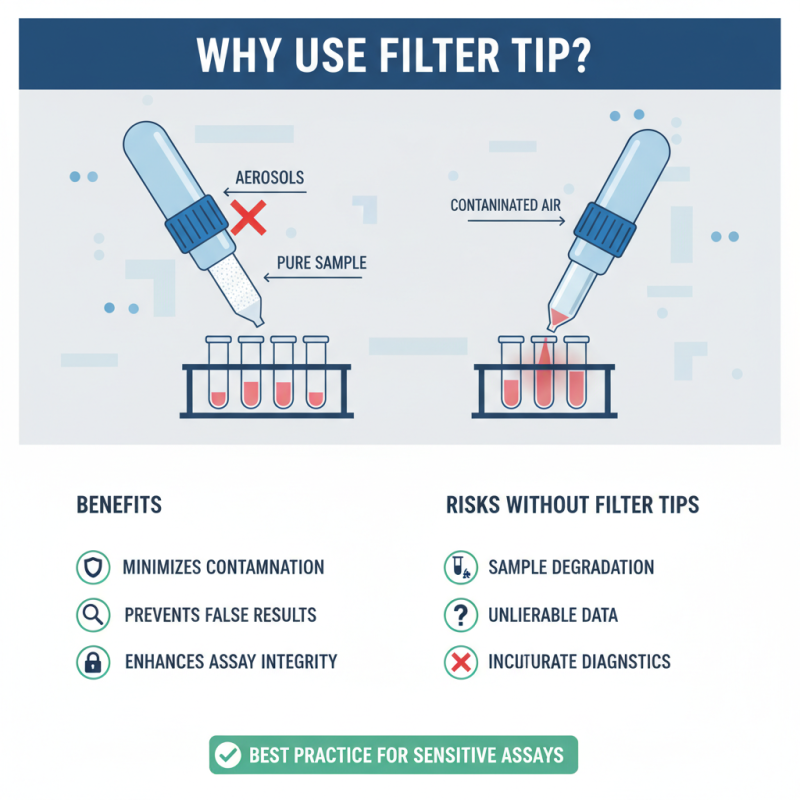
Why use a filter tip for sensitive PCR assays? The answer lies in their design. Filter tips are engineered to prevent aerosols from contaminating samples. They act as a barrier, ensuring that even the tiniest particles do not compromise results. This feature is especially important when working with low-template DNA where any contamination can lead to false positives or negatives.
Despite the advantages, not all laboratories adopt filter tips regularly. Some researchers remain skeptical or unaware of the benefits. This raises questions about best practices in sensitive assays. Ensuring the reliability of PCR results is paramount, and using a filter tip is a straightforward yet effective step to enhance assay integrity. Exploring this topic reveals both the consensus on its importance and the gaps in its application in various settings.
Advantages of Filter Tips in PCR Assays for Sensitivity
In PCR assays, achieving high sensitivity is crucial for accurate results. Filter tips provide a significant advantage in preventing contamination and enhancing assay reliability. The use of filter tips helps eliminate the risk of aerosols, which can introduce unwanted nucleic acid contamination. According to a report from the Journal of Molecular Diagnostics, using filter tips can reduce contamination rates by over 90%. This reduction directly correlates to improved assay sensitivity, which is key in detecting low-abundance targets.
Implementing filter tips can also minimize sample loss. Stories from research labs indicate that using regular tips often leads to residual liquid, compromising the PCR results. In contrast, filter tips effectively retain liquid without suction, ensuring complete transfer. This feature has been noted to enhance overall reproducibility in sensitive assays significantly.
While filter tips are effective, not all labs utilize them. Some researchers opt for traditional tips, citing cost constraints. However, the potential expenses of false positives or negatives can outweigh the initial savings. Adopting filter tips may require an upfront investment but can lead to consistent, reliable results in the long run, minimizing the need for repeated experiments.
Understanding the Mechanism of Filter Tips in Preventing Contamination
Filter tips are vital in sensitive PCR assays due to their ability to prevent contamination. This contamination can arise from various sources, such as aerosolized particles or cross-contamination from different samples. Filter tips act as a barrier. They trap the contaminants while allowing accurate and reliable sample transfer.
The mechanism behind filter tips is straightforward yet effective. They contain a membrane that captures aerosols or droplet splashes during pipetting. This feature is crucial in PCR, where even minute amounts of contaminating DNA can lead to false positives. Users of filter tips report a significant reduction in contamination incidents. However, it is essential to ensure proper pipetting techniques to maximize their effectiveness. Poor handling could still compromise results.
Despite their advantages, filter tips are not infallible. They may create additional resistance, which can affect pipetting accuracy. Users must calibrate their techniques accordingly. Regular training and practice can help mitigate such issues. Overall, understanding the role and limitations of filter tips in PCR is essential for achieving reliable and reproducible results.
Impact of Filter Tips on PCR Assay Contamination
Impact of Filter Tips on Reaction Efficiency and Yield in PCR
In the world of PCR assays, using filter tips can significantly enhance reaction efficiency and yield. These tips prevent contaminants from entering the reaction. This precaution is critical for sensitive assays. Contamination can lead to false results or compromised data integrity. So, filter tips become essential tools in any PCR setup.
Reaction efficiency is often correlated to the quality of the pipetting tools used. Filter tips help maintain clean conditions during the transfer of reagents. They minimize the risk of aerosol contamination, which can disrupt the PCR process. Researchers report improved yield when using filter tips, particularly in low copy number scenarios. However, one must consider the cost implications of these tips. They can be more expensive than regular ones, a factor that some labs need to address.
There is always a learning curve associated with new tools. While filter tips offer clear benefits, some users might struggle with their handling. Proper training is essential to maximize their potential. Each lab's setup varies, so the universal application may not hold. Balancing efficiency with cost-effectiveness remains a critical topic for discussion in the scientific community.
Best Practices for Using Filter Tips in Sensitive PCR Assays
In sensitive PCR assays, minimizing contamination is critical.
Filter tips serve an essential role in this context. They act as a barrier, significantly reducing the risk of liquid transfer contamination. A study published in the journal "Nature" indicated that up to 50% of PCR failures could be attributed to contamination. This reinforces the importance of using filter tips in such sensitive protocols.
Best practices suggest using filter tips for every pipetting action in high-stakes experiments. It's wise to change tips between samples to prevent cross-contamination. Experts recommend a two-step pipetting method in which the first PCR mix is transferred with one filter tip, while the following reactions use a new tip. Additionally, maintaining the sterility of your workspace enhances the reliability of results.
However, filter tips can sometimes lead to issues like decreased accuracy in pipetting. A report from "Analytical Biochemistry" noted that some researchers experienced variability in small volume transfers. They encouraged the careful selection of filter tips to mitigate this problem. This highlights the need for well-informed choices in laboratory practices, as there remains room for improvement in handling and using filter tips effectively.
Comparison of Filter Tips vs. Regular Tips in Molecular Biology Applications
In molecular biology, the choice of pipette tips can significantly impact assay performance.
Filter tips are designed to prevent aerosols and contamination.
This is especially true in sensitive PCR assays. They can minimize the risk of cross-contamination between samples.
A study highlights that using filter tips can reduce contamination rates by up to 80% compared to regular tips.
Certain molecules are prone to degradation during handling.
Regular tips may allow sample loss due to evaporation.
Filter tips provide a barrier that mitigates this loss, preserving valuable reagents.
Reports show that using filter tips improves assay specificity, helping researchers achieve reliable results.
In one analysis, experiments utilizing filter tips demonstrated a 25% increase in amplification success rates.
Despite these benefits, filter tips may introduce some challenges.
They can increase reaction volumes and offer limited compatibility with specific pipetting techniques.
Some researchers express concerns regarding the increased cost and waste associated with filter tips.
Balancing these factors is crucial.
Selecting the right tip requires evaluating the specific needs of your application.
Adjustments may be necessary to optimize performance during sensitive assays.
FAQS
: Filter tips help prevent contamination in PCR assays. They enhance assay reliability by protecting against aerosols.
Using filter tips can reduce contamination rates by over 90%. This leads to better detection of low-abundance targets.
Yes, filter tips retain liquid effectively without suction. This ensures complete transfer and enhances reproducibility.
No, some labs prefer traditional tips due to cost. However, this choice may increase the risk of false results.
Filter tips prevent contaminants from entering the reaction. This maintains data integrity and improves overall yield in PCR.
No, some users may struggle with handling them. Proper training and practice are essential for optimal results.
Always use filter tips for pipetting actions. Change tips between samples to avoid cross-contamination.
Yes, there can be variability in small volume transfers. It's crucial to choose high-quality filter tips to try to avoid this.
A sterile workspace prevents contamination, ensuring reliable PCR results in sensitive experiments.
The cost is a main concern. Also, some might need more experience to handle them effectively, which can impact results.
Conclusion
The article "Why Use a Filter Tip for Sensitive PCR Assays?" explores the significant advantages of using filter tips in PCR assays, particularly for sensitive applications. One key benefit is their ability to prevent contamination, which is vital for maintaining the integrity of PCR results. The mechanism behind filter tips helps to trap contaminants and aerosols, ensuring a cleaner, more reliable reaction environment. This leads to improved reaction efficiency and higher yields, which are crucial in sensitive PCR assays where precision is paramount.
Additionally, the article discusses the best practices for utilizing filter tips effectively, as well as comparing their performance with regular tips in various molecular biology applications. By emphasizing these factors, researchers can make informed decisions about their pipetting tools, ultimately enhancing the reliability and accuracy of their PCR assays. Overall, understanding "why use a filter tip for sensitive PCR assays" is essential for any lab aiming to achieve optimal results with minimal risk of contamination.
 Breeze Medical
